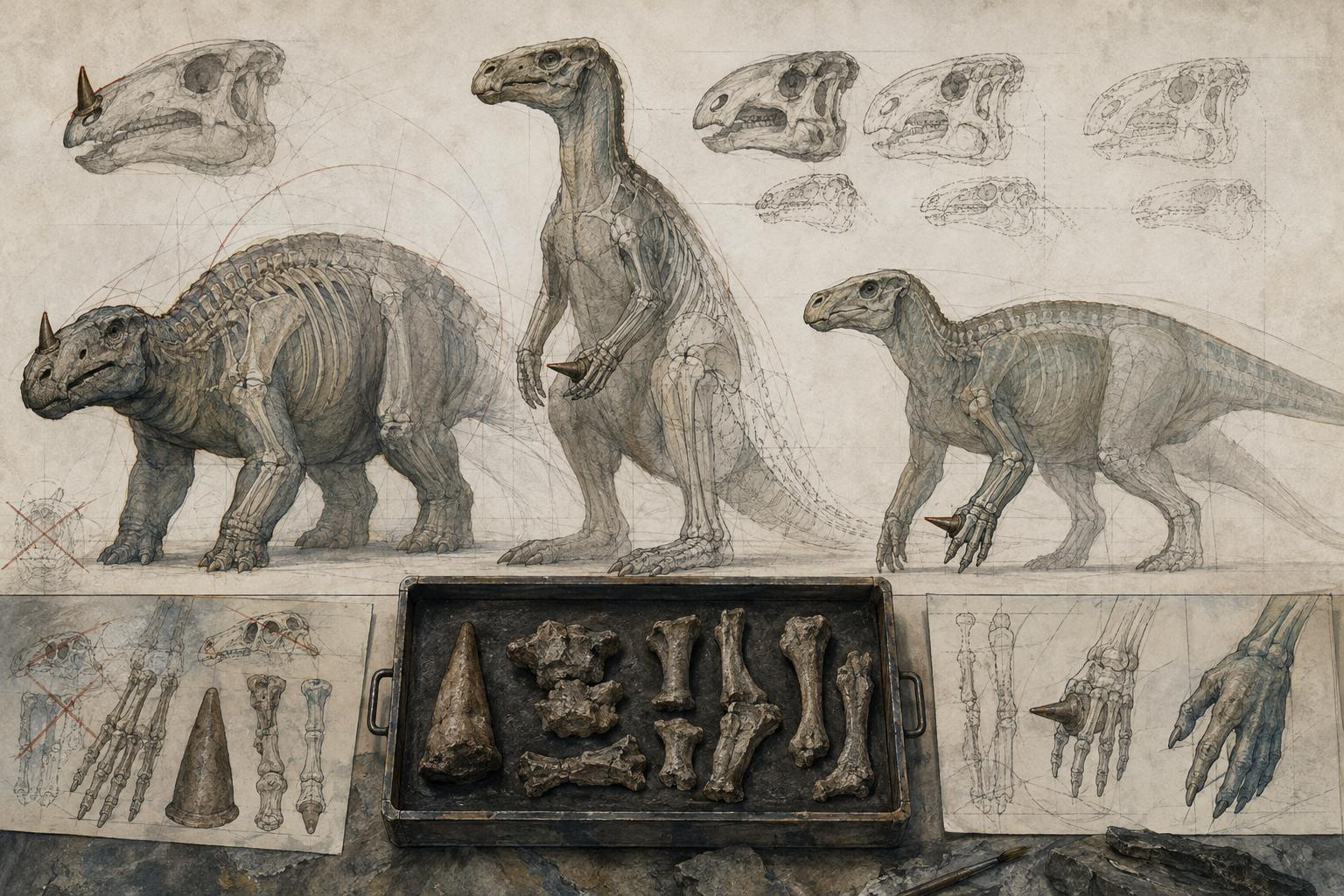
Opening plate. The same surviving evidence supports three changing Iguanodons: the Victorian horn-nosed animal, the upright Bernissart mount and the modern horizontal reconstruction. Conceptual editorial illustration.
How can real bones produce the wrong animal?
The animal with a horn on its nose
In a park in south London, an Iguanodon still wears its thumb on its face.
It has been there for more than 170 years. Rain has run down its back, seasons have gathered in the folds of its stone skin, and generations of children have met it as a dinosaur before they were old enough to know that dinosaurs could be reconstructed incorrectly.
The strange thing is that almost every important part of it began with real evidence. The teeth were real. The bones were real. The great conical spike was real. But when the Crystal Palace dinosaurs were built in the 1850s, there was no complete Iguanodon skeleton to show where all those pieces belonged.[1]
So the spike became a horn, and the rest of the animal grew around it: heavy, low, four-legged, rhinoceros-like. A huge reptilian body was assembled around the fragments that had survived.
It was not a careless fantasy. It was a serious scientific reconstruction made from the best evidence and comparisons available at the time.
It was also wrong.
How can real bones produce the wrong animal?
The easy answer is that the Victorians did not know enough. But nobody ever knows everything when reconstructing something that can no longer be observed directly. That is what makes reconstruction necessary in the first place.
The harder answer is that a bone never arrives with the rest of the animal attached. Somebody has to decide what goes around it.
The Crystal Palace Iguanodon is therefore two fossils at once. Beneath the reconstruction lies evidence of an extinct animal; around that evidence stands a Victorian idea of what such an animal could be. One preserves part of a body. The other preserves an act of inference.
At first, those two things look inseparable. The horn appears to belong to the dinosaur.
Then, deep beneath a Belgian town, the animal begins to break apart.
The animal refuses to stay finished
In 1878, miners working 322 metres below Bernissart cut into a pocket of dark clay and found bones. Not another isolated tooth or suggestive fragment, but whole skeletons. Enough of them to make the old Iguanodon difficult to defend.[2]
The spike moved from the nose to the hand, and the horn became a thumb. The rhinoceros-like body rose onto two legs, its tail stretching behind it. A new Iguanodon entered museums in an upright, kangaroo-like pose.
This must have felt like resolution.
The fragments had been replaced by skeletons. The animal had finally revealed itself.
Except it had not.
A century later, a new anatomical review showed that the upright pose forced the spine and tail into positions they could not naturally hold. Iguanodon came down again. Its back became more horizontal and its forelimbs returned towards the ground. The better skeleton had produced a better animal, but not a finished one.
The mounted originals at Bernissart still stand in their older posture because the bones are now too fragile to rearrange.[2] Another museum therefore contains another double fossil: inside the glass is an animal from the Cretaceous, while holding it upright is a nineteenth-century interpretation of that animal. The skeleton and the scientific history occupy the same body.
Iguanodon was not uniquely difficult. For much of the twentieth century, dinosaurs were commonly shown as slow, heavy reptiles. Then John Ostrom described Deinonychus, an animal built around balance, speed and active predation.[3]
The old bodies began to move.
Later, fossils from China preserved coverings that bone alone could never have announced. Filaments appeared, then feathers with recognisable structures. Some non-avian dinosaurs had not merely been bird-like in a loose, imaginative sense; parts of their bird-like bodies had survived directly in stone.[4]
The old bodies began to soften.
Then colour entered the reconstruction. Microscopic structures associated with pigment allowed researchers to infer reddish-brown banding in the tail of Sinosauropteryx.[5] Preserved pigmentation on Psittacosaurus was mapped onto a life-sized model and compared with patterns of light and shadow, allowing its countershading to become evidence about the habitat in which it lived.[9]
Colour was no longer decoration added after the science was finished. It had become another way of testing the animal against its world.
Even the mouth remained unsettled. Were the great teeth of large theropods permanently exposed, or covered by scaly lips? A 2023 study compared tooth wear, skull anatomy and living reptiles and argued for tissues covering the teeth.[8] The debate has not ended, which is precisely what makes it useful: a reconstruction can become better supported without becoming final.
For nearly two centuries, each new animal appeared to correct the last. Then each correction revealed another layer that had quietly come from the observer. The horn was not in the fossil. The upright posture was not in the fossil. The thin skin stretched tightly around bone was not in the fossil. Some later feathers were in the fossil; others were inferred because preserved anatomy and living relatives made them increasingly difficult to exclude.
That difference matters. The fossils did not suddenly grow feathers. Our reconstruction changed because we stopped treating the preserved skeleton as the entire animal.
This is the deeper story of dinosaur reconstruction. It is not a procession from foolish pictures to correct pictures, but a record of people learning to separate what they found from what they supplied.
And the more alive the dinosaurs became, the stranger the original question became.
How much of the animal was inside the fossil, and how much was inside the observer?
What survived is not what existed
Imagine following one dinosaur after death.
The animal falls, and most of what made it an animal begins to disappear almost immediately. Heat leaves the body. Muscles relax. Colour fades. Cells break down. Scavengers arrive. Soft tissues are consumed, scattered or dissolved; bones separate; water moves them; sediment covers some and leaves others exposed.
Then chemistry takes over. Minerals enter spaces where living material used to be. Pressure compacts the surrounding sediment. Rock forms, shifts, heats, fractures and erodes. Millions of years pass before a piece returns to the surface.
Even then, survival is not enough. Somebody has to notice it. It has to be excavated without destroying the feature that matters, prepared without removing a trace mistaken for dirt, placed in a collection, labelled, scanned, compared and interpreted.
By the time a fossil reaches a museum drawer, nature and human attention have already performed a long and extraordinarily biased experiment.
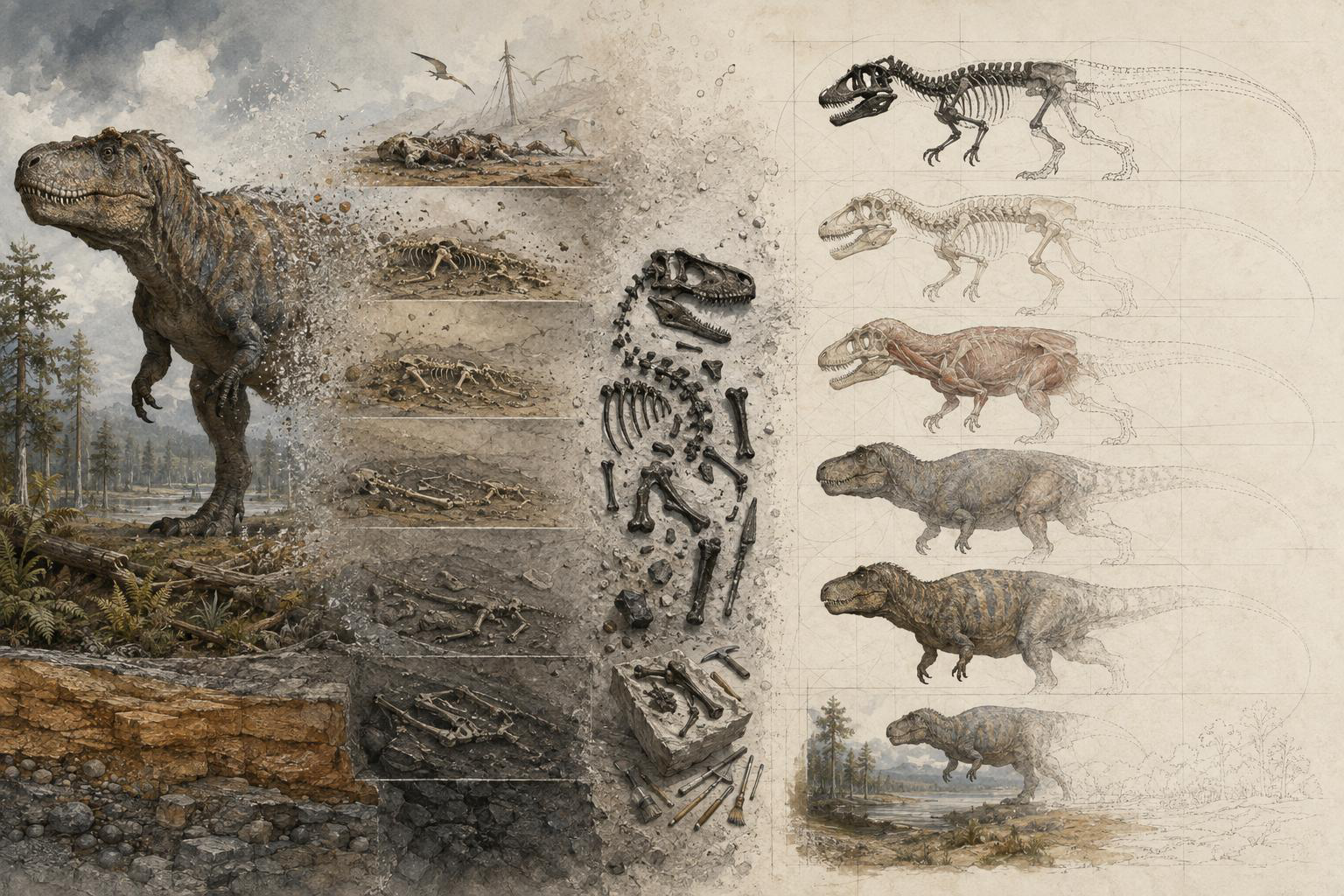
Palaeontologists call the study of this passage taphonomy. It examines what happens between life and the evidence that later becomes available to us.[7]
Fossilisation is not a camera. It is a filter. Reconstruction is the attempt to travel back through what the filter left behind.
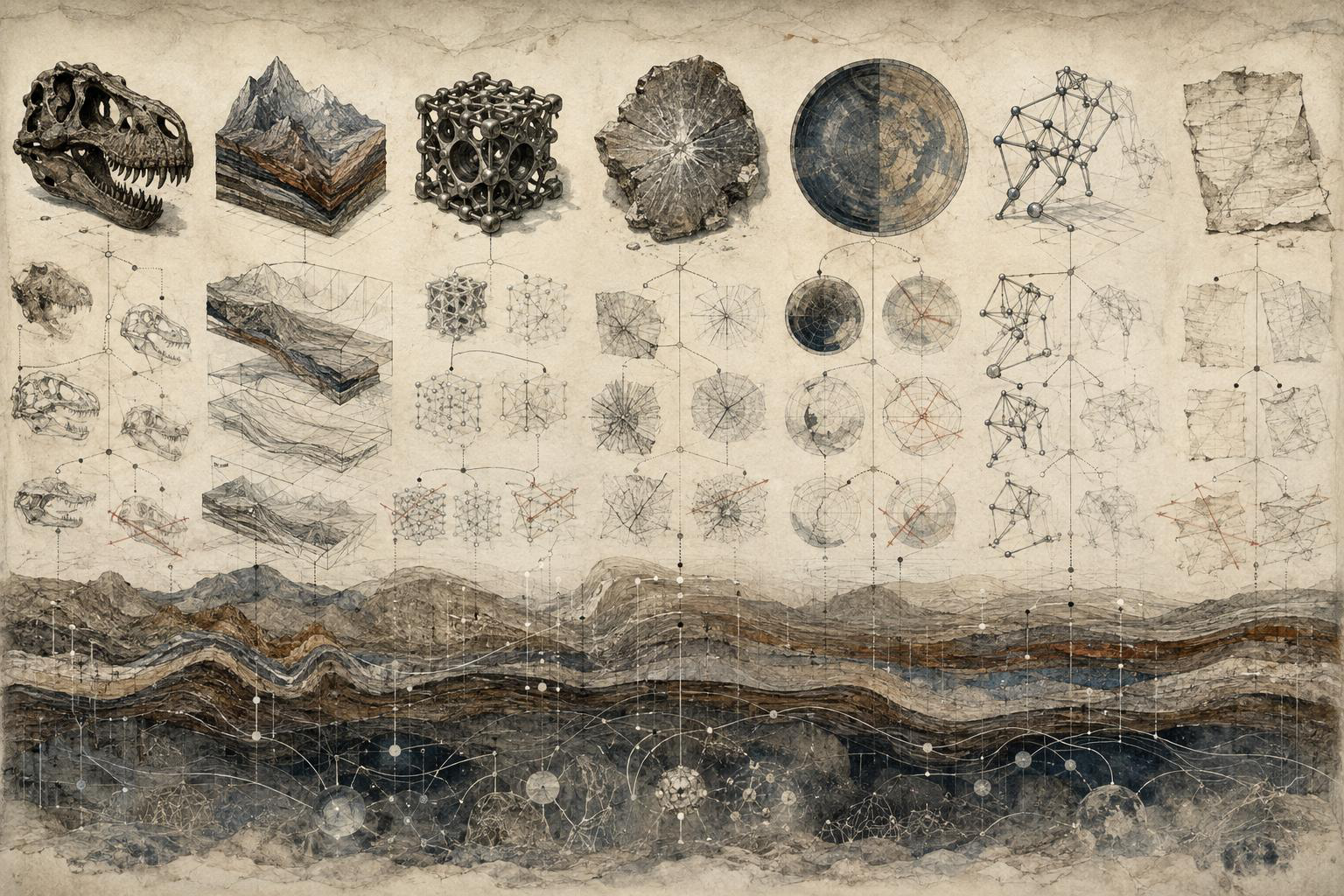
Figure 1. Evidence travels inward through selective loss; reconstruction travels outward through layers of unequal inference. The two movements are related, but they are not reversals of equal certainty.
Bone and teeth usually survive more readily than organs and behaviour. Rapid burial can preserve details ordinary decay removes. Rivers collect different remains from deserts, and large animals enter the record differently from small ones. A single bed of fossils may compress organisms from different years, centuries or longer into what looks like one moment.
What we observe is therefore not simply the original animal, reduced in quantity. It is the original animal transformed by the route through which it became observable. The living body shaped what could decay; decay shaped what burial could preserve; burial shaped what chemistry could transform; preparation shaped what a researcher could see.
The filter does not merely sit outside the evidence. It participates in making the evidence available to us.
Structure is history after filtering.
Not simply history, but history after loss, transformation, amplification and erasure. That is why the bones can be real and the animal around them can still be wrong. The evidence does not deceive us; it simply cannot display everything that failed to survive.
The danger begins when we forget that absence.
Palaeontology has developed ways to reason through it. One is the extant phylogenetic bracket, which uses living relatives to constrain what may plausibly be reconstructed in extinct animals.[6] For non-avian dinosaurs, birds and crocodilians become more than visual inspiration. They become living comparison cases.
If a soft-tissue structure exists in both branches and has a known relationship to bone, the inference becomes stronger. If it exists in only one branch, or leaves no skeletal trace, the claim becomes more conditional. This does not remove imagination; it gives imagination load-bearing walls.
A preserved feather is direct evidence. A muscle reconstructed from attachment sites and living relatives is a strong anatomical inference. A particular mating display in an animal without preserved soft tissue may remain possible, but weakly constrained. Not every addition around the skeleton has the same authority.
That is how a reconstruction becomes scientific. Not by refusing to build beyond what survived, because then we would have nothing but disconnected bones, but by keeping the joins visible.
What was observed, and what was inferred? What filtered the record? What other histories could have produced the same remains? If this reconstruction is right, what else should be present?
The last question is crucial because it turns a story into a test. Change the comparison animal and see which muscles still make sense. Change the posture and see whether the joints can still move. Add the proposed soft tissue and ask whether the body can still breathe, balance, feed or live in the habitat claimed for it.
The aim is rarely to recover one perfect autobiography from one structure. Different histories can leave similar traces; information is destroyed, and some variables were never measured. The aim is to shrink the space of viable histories: to build several possible animals around the bones, then remove the ones that cannot stand.
Outside the museum
Once this way of seeing clicks into place, it does not stay inside the fossil gallery.
Leave the museum and the world outside begins to look different. The stone beneath your feet has been fractured, transported, cut and laid. The shape of the hill records uplift and erosion older than the city on top of it. A road bends around a boundary that may outlive the people who drew it. A steel railing carries, invisibly, the thermal and mechanical history of its manufacture.
The world is crowded with structures produced by processes we did not witness. Many sciences already read them this way; they simply use different words.
Geologists do not have to watch a mountain rise from beginning to end. They read folded strata, displaced faults, mineral assemblages, sediment layers and eroded gaps. A valley is tested against water, ice, uplift, weathering, rock type and time. The landscape is not merely scenery. It is movement that has become structure.
Materials science taught me this before I had language for it. Here is the puzzle.
Two pieces of metal can contain the same elements in the same overall proportions and still behave like different materials. One bends where the other cracks. One survives a load that destroys the other. How can the chemistry stay the same while the material changes?
Cut each piece open, polish it until the surface becomes a mirror, then etch it and place it beneath a microscope. A hidden landscape appears: grains and boundaries, phases, precipitates, voids, inclusions and distortions. The image does not arrive with labels saying cooled quickly, worked here, held too long at temperature or contaminated before solidification. But those processes have left descendants.
The answer is history. Heating lets some structures form and prevents others. Cooling traps arrangements before equilibrium. Deformation stretches grains and multiplies defects. The environment attacks whatever the final structure leaves exposed. Composition names the ingredients; processing decides what they become.
A microstructure is not just a picture of what a material is. It is evidence of what the material has survived.
The failure is already over. The force is gone. The crack has stopped moving. By the time an engineer arrives, the component is silent.
So how do engineers know what happened?
The fracture answers with terrain: ridges, branches, arrest marks, changes in texture, and a small origin from which failure found a viable route across the material. The surface is a witness, but not a confession.
A crack pattern can constrain the loading history without uniquely identifying it. Impact, thermal shock, fatigue and residual stress can leave overlapping effects. Calling a fracture “brittle” may correctly describe its appearance while missing the temperature, geometry or repeated loading that made brittle behaviour locally possible.
So the engineer does what the palaeontologist does. They propose histories, then ask what else each history should have left behind. If impact began the crack, where should the origin be? If thermal shock drove it, what temperature gradient would be required? If fatigue dominated, should repeated growth markings appear?
The best explanation is not the story that fits one mark most beautifully. It is the history that survives the largest number of independent constraints.
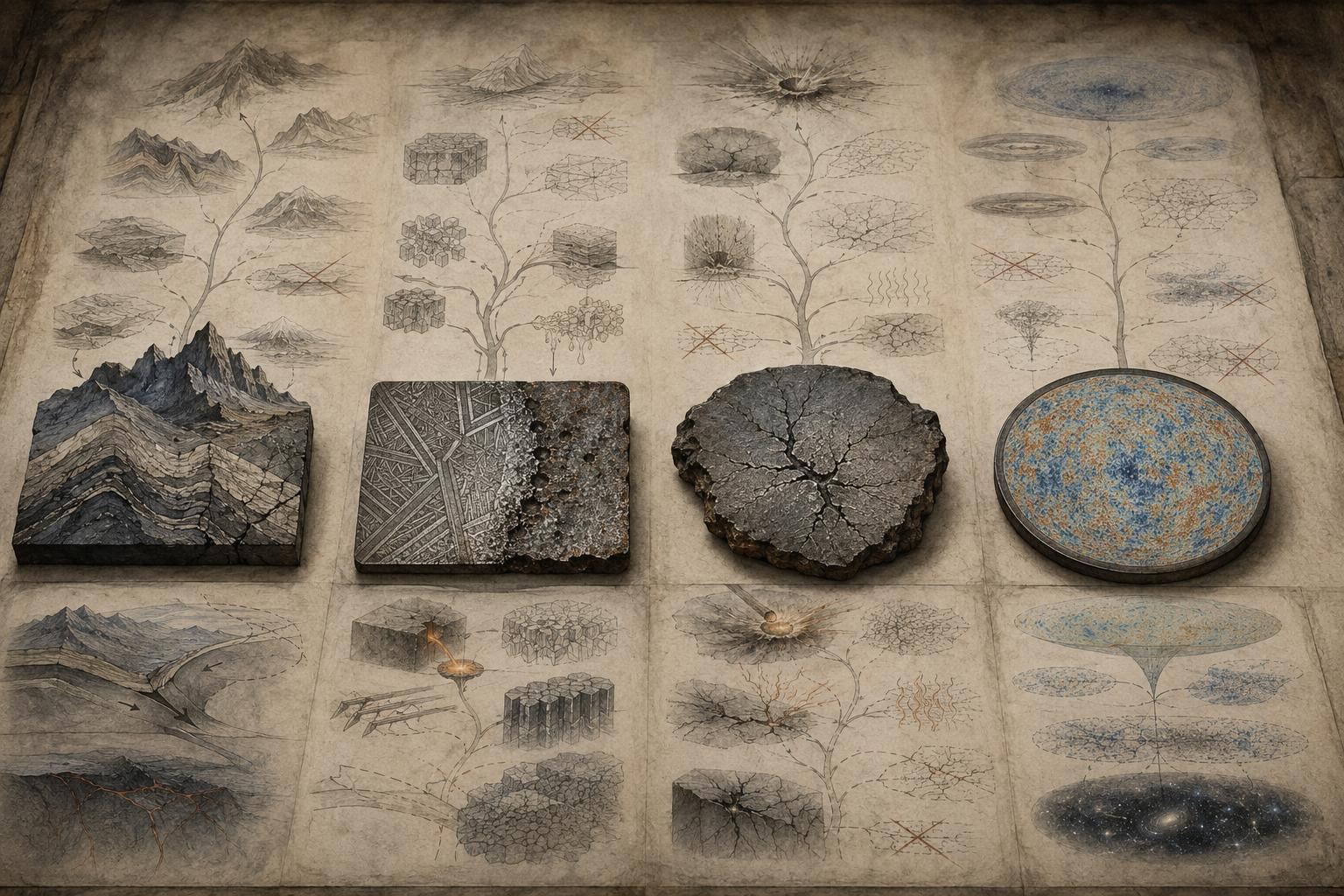
Then the scale expands. Put these surfaces beside one another and the family resemblance is stranger than the objects: each is a surviving structure with a missing verb.
Look up, and the sky becomes another witness surface.
Figure 2. A museum of witness surfaces: folded strata, metallic microstructure, fracture terrain and oldest light each constrain processes that were not directly observed. Shared method does not imply shared mechanism.
The oldest light is not a photograph
The oldest light we can see is not light from the beginning. It is light from the moment the universe finally became transparent enough for that evidence to escape.
That trace is the Cosmic Microwave Background. It is often called the universe's baby picture. But it records neither a baby nor the beginning. It records a threshold: the moment an opaque universe became transparent enough for light to travel freely.
But a photograph normally implies that a scene already existed, light left it, and a camera captured the light more or less directly. The Cosmic Microwave Background arrived by a stranger route.
For roughly the first 380,000 years, the universe was filled with a hot plasma. Photons could not travel freely across it because they repeatedly scattered from free electrons. The early universe did not merely look foggy from the outside; there was no outside view from which its earlier light could have reached us.
Expansion cooled the plasma. Atomic nuclei captured electrons. The fog cleared, and photons that had been trapped in repeated interactions could finally travel over enormous distances.[10]
That release is what the map lets us see.
Not the beginning of the universe, but the moment the universe became transparent enough for this particular evidence to escape.
Even then, the image did not simply wait, unchanged, to be discovered. Expansion stretched the radiation into microwave wavelengths. Matter along the route bent some of its paths. Later electrons scattered a fraction of it again. Our own galaxy laid brighter microwave emissions across the same sky. Instruments measured signals in different frequency bands, and mathematical reconstruction separated the faint background from foregrounds, noise and systematic effects.[11]
The familiar red and blue oval is therefore not a literal colour photograph. It is a map built from measurements of tiny temperature differences in radiation that has already passed through several physical and observational filters.
None of this makes the map less real. It makes the map more interesting.
The light is genuine, the temperature variations are genuine, and the precision of the measurements is extraordinary. But the image is both an ending and a beginning: the end of a long period in which radiation and matter were tightly coupled; the beginning of the oldest light now available for us to observe; and the beginning of another history in which that light is stretched, bent, mixed with nearer emissions, detected and reconstructed into something a human can see.
The snapshot has a past on both sides of the shutter.
That changes how it should be read. A hot patch is not a little object floating on the surface of the early universe, and a cold patch is not a blue place we could have visited. The pattern is the surviving consequence of earlier density, motion and pressure conditions, expressed through radiation at the point it could finally travel freely.
Like a fracture surface, it constrains a history without narrating that history by itself. The useful question is therefore not only what does the map contain? It is what sequence of processes had to occur for this map to become observable, and what else should that sequence have left behind?
That means keeping the joins visible. Which features belong to the received radiation? Which were separated as foreground? Which conclusions depend on the reconstruction model? Which proposed histories also account for the radiation's polarisation, its statistical pattern and the structures that appeared later?
A measurement can be exquisitely accurate and still be historically under-read. That is the problem I explored at full length in an earlier essay, The Problem with Snapshots: Reading the Microstructure of the Cosmos.[12]
The answer is not to distrust the picture. It is to reconstruct the route by which the picture became possible.
Then look down at the phone in your hand.
Can a model beat nonsense and still be useless?
Imagine a thermometer.
It performs better than random guessing.
It is still completely useless.
How can all three statements be true?
Something very similar happened in one of my materials audits. The result was not a hypothetical warning. It emerged from a completed four-target experiment.
To understand how, begin with the ranking a model gives its inputs. It looks like a list of what matters. But a feature ranking is not a window with the glass removed. It is a fossil of optimisation.
A trained model is another structure with an inaccessible history compressed inside it. What was collected and excluded, how the population was split, which variables were available, which objective was optimised and which model family was chosen all leave descendants in the finished result. So how do we discover which parts belong to the underlying problem and which belong only to the route the model happened to take?
We disturb the reconstruction.
That is the idea behind an audit I built called Geatomica. Its controlled transformation layer, Governed Invariance Logic, changes one declared condition at a time: the data population, the descriptors available, the model family, the sample size or the quality of the inputs. Then it records what persists, what deforms and what fails. It does not treat survival under a finite set of tests as universal truth. It asks a narrower and more useful question: within the changes we actually declared, which parts of this interpretation remain difficult to remove?
One four-target materials experiment began promisingly. When descriptors tailored to the target were added, the median full-scale score for formation energy rose from 0.675 to 0.747. For band gap it rose from 0.559 to 0.719.[13] Those numbers are not percentages of “accuracy”; they compare the model with the simple baseline of predicting the average. Still, the improvement was real. Information that mattered to one physical property did not matter in the same way to another.
Then the population changed. Instead of allowing chemically related materials to appear on both sides of the test, whole chemical or composition groups were held back. Performance fell, but useful signal remained for formation energy and band gap. The result was neither “the model generalises” nor “the model fails”. It was more precise: part of the relationship travelled beyond the easiest population arrangement, and part of it did not.
So far, this is what we hope an audit will find: a promising reconstruction becoming more carefully bounded.
Then the elastic-property results produced a stranger question.
To check whether a model has learned anything, researchers often compare it with a deliberately broken version trained against shuffled targets. If the real model beats that null comparison, we say there is signal. In the elastic lane, the model did beat its null.
Under the first aggregation rule, that counted as support.
There was only one problem: its absolute predictions were still unusable.
One of the audit's scores, called R-squared, asks whether a model predicts better than simply using the average value. A score below zero means it does not. The elastic model had beaten the deliberately weakened comparison while still failing that ordinary standard. It had become better than nonsense without becoming good.
Relative improvement is not the same as viability.
This sounds like a technical edge case until the shape of the mistake becomes visible. A broken thermometer may outperform a random number generator and still be a broken thermometer. A treatment may help more than doing nothing and still leave a person critically unwell. An institution may outperform a failed comparator while continuing to fail the people inside it.
The corrected rule therefore needed two doors. A result had to separate from the null, and it also had to cross an absolute threshold of usefulness. Passing one could no longer quietly impersonate passing both.
The most important result was not that the audit had perfectly protected itself from the beginning. It had not. The important result was that the completed audit exposed a defect in its own rule, preserved the original evidence and refused to turn relative success into scientific authority.
The data population had another warning inside it. Elastic values with physically questionable signs and extreme magnitudes could dominate what the model learned, so the elastic interpretation was held back pending a separately defined admissibility test. The failed lane did not prove that elastic properties were unpredictable. It showed that a model cannot tell us what a population means before we have decided whether that population is physically and numerically fit to interpret.
Once again, the filter was not outside the evidence. Admission rules helped make the evidence the model was able to produce.
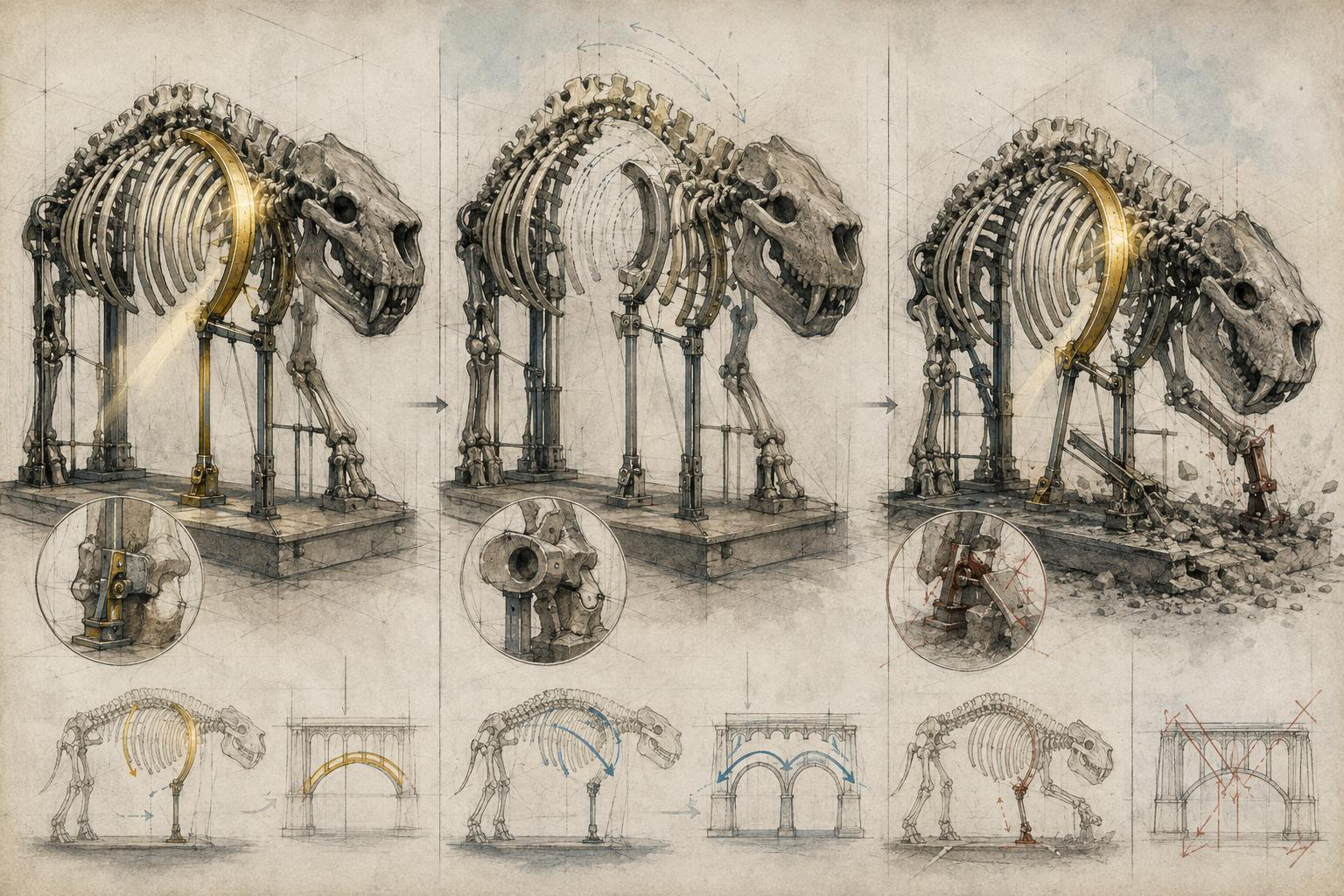
An earlier bulk-modulus pilot revealed a different fracture line. Volume per atom looked far more important than density when I disturbed the finished model one feature at a time. Yet when I removed each descriptor and trained the whole model again, density proved much harder to replace. The brightest bone was not the one the skeleton could least afford to lose.
Figure 3. Importance is not necessity. Removing a visually dominant route may permit compensation; removing a quieter load-bearing route may collapse the reconstruction.
Both observations were real. They were simply answering different questions.
The first asked where this fitted model happened to route information. The second asked what the modelling process could reconstruct when one route was removed. One described reliance inside the finished skeleton; the other tested what happened when a bone was taken away.
That distinction is the centre of the experiment. “Important” is not one property waiting to be measured. A descriptor may look dominant, remain stable across disturbances, or prove consequential when removed, and those are different forms of evidence. If they disagree, the disagreement is not clutter to be averaged away. It is the place where the reconstruction becomes visible.
The model output remains real. The audit does not dissolve it into uncertainty; it gives the output a history, a boundary and a set of joins. It shows which parts belonged to one fitted arrangement, which persisted across declared changes, which were replaceable, and which should not yet be interpreted at all.
At every scale, the move is the same. Do not stop at what is this? Ask how did this become this, and what happens when the route is disturbed?
When someone mistakes your skeleton for you
It is easy to enjoy this as a scientific trick: an elegant way to read dinosaurs, metals, mountains, maps and models.
Then the method turns towards people.
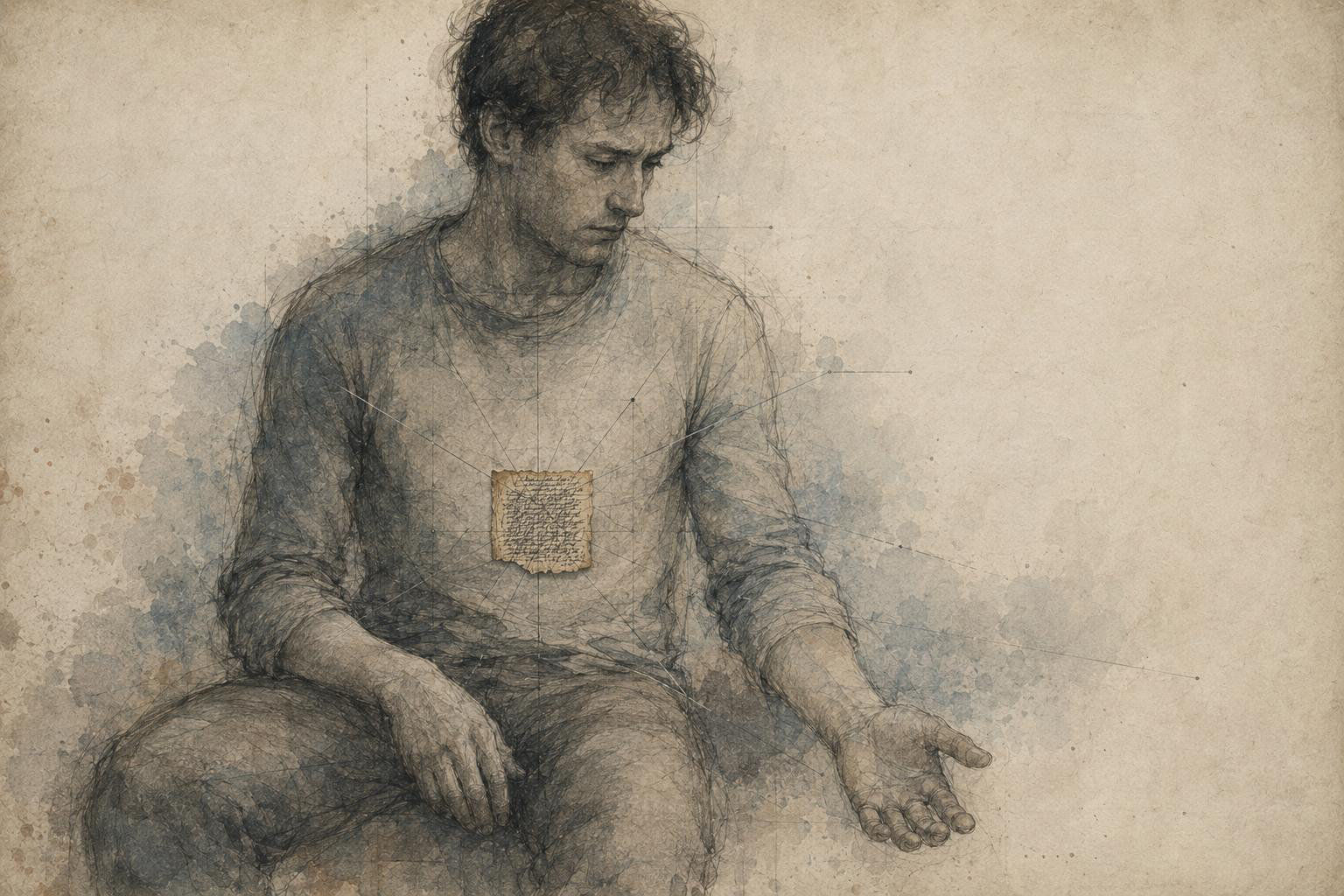
A person sits an examination while their body is under severe load. Thirty minutes survive on the page. The paper exists, the marks are real and the missing answers are real. From the outside, the structure looks simple: this is the work the person produced.
The output is real. The missing answers are real. But what kind of person is being reconstructed around that surviving fragment?
Performance is not identical to capacity. Visible output may be what survived after pain, illness, fear, timing, accessibility, medication, support and recovery cost filtered everything else away. That does not make the output false; it makes it incomplete historical evidence.
A medical test works the same way. The number may be accurate for the sample taken, but the sample passed through timing, posture, hydration, medication, reference ranges, measurement limits and the decision about what to test in the first place. Biology did not walk into the clinic unfiltered.
A person can be measured correctly and reconstructed badly.
Figure 4. A person can be measured correctly and still be reconstructed badly. The examination paper is real evidence, but it is only the fragment that survived the moment. To treat that fragment as the whole person is to mistake an observable output for the life and system that produced it.
The mistake is painfully familiar. A short period of visible function becomes evidence of stable capacity. A good conversation becomes evidence that the body is coping. A completed piece of work erases the hours or days of recovery around it. The part that survived becomes the whole animal.
The null-comparison mistake returns in human form. Someone may be functioning better than yesterday without being well. They may complete more than another person without being properly supported. They may force an output through a failing system and have that output used as evidence that the system works.
Beating something worse does not prove viability.
This is where the dinosaur stops being a charming analogy. The danger is not that people build around incomplete evidence; we have to. No clinician, teacher, institution or other person receives an entire life directly. The danger begins when we forget which parts were found and which parts were supplied by us.
Low performance becomes low ability. Inconsistent performance becomes inconsistent effort. A normal snapshot becomes a normal system. A policy becomes how an institution behaves. A memory becomes the event exactly as it occurred. A model output becomes physical truth. Bones become an animal.
Each move may begin with something real. The error grows in the tissue placed around it.
There is no way to stop reconstructing. The answer cannot be to refuse all interpretation until every variable is known; that would leave us surrounded by bones we are too frightened to assemble. The better discipline is to make construction visible.
Start with what actually survived, then ask what filtered the record. Allow more than one history to produce it and turn each history into consequences: what else should be present if this account is right?
Then change the lens. Change the scale, the measurement, the comparison case or the population. Look for the parts of the reconstruction that remain standing. The result may not be one recovered history; often it is a smaller, better-bounded set of possible histories.
That is still explanation.
It is explanation with the joins left visible.
The temptation to finish the animal
Humans dislike unfinished reconstructions. Give us half a skeleton and we will build a whole animal. Give us a trend and we will build a cause. Give us a ranking and we will build a mechanism. Give us a policy and we will build an institution that behaves as written.
The finished animal is cognitively satisfying. It also hides the decisions that completed it.
Good palaeoart has to make choices. An image cannot remain a cloud of confidence intervals; the animal needs skin, volume, posture and some relationship to the world around it. But responsible reconstruction knows that not every choice has the same evidential weight.
It should be possible to point to the bone, the muscle and the decorative feather separately. It should be possible to say which part would disappear if the comparison changed, and to leave a region unfinished when the evidence cannot yet support a body around it.
This is not permanent uncertainty.
It is honest assembly.
The animal in the park
Return to Crystal Palace and the Iguanodon has not moved. The thumb is still on its face, and the great body still sits with the confidence of an animal that once appeared scientifically complete.
But it is harder to call it simply wrong now.
It contains genuine nineteenth-century evidence of Iguanodon. It contains comparisons with living reptiles and large mammals. It contains the absence of the Bernissart skeletons, because those skeletons had not yet been found. It contains the scientific limits of its time and the very human need to turn fragments into something that could stand in a park.
The statue is a fossil of a dinosaur reconstruction. It preserves not only what Victorians knew, but how they filled the space around what they did not know.
That makes the horn useful again.
Not as anatomy.
As a warning.
The harder question is which of our own reconstructions carry the same mistake in places we can no longer see. Which measurements are we treating as whole systems? Which outputs are we treating as capacities? Which models are we treating as mechanisms? Which surviving structures are we mistaking for complete organisms?
We often imagine that the past is gone. In practice, it is everywhere. It survives as landscapes, microstructures, institutions, habits, datasets, scars, models, bones and memories.
The difficulty is not finding traces of history. It is learning how to read them without confusing what survived for everything that existed.
That is why a world full of fossils is not a dead world. It is a world crowded with unfinished explanations. Put the traces in the same cabinet and the shared problem becomes difficult to miss.
Figure 5. A world full of fossils: bones, landscapes, microstructures, fractures, cosmological maps, model outputs and examination papers are surviving traces with histories extending beyond what remains visible.
Every structure is an invitation to look backwards, not with unlimited imagination, but with disciplined reconstruction. Observe what survived. Account for the filter. Infer the viable histories. Find the constraints they share. Test what else those histories should leave behind.
Then say only what survived the journey back.
The fossil is not the whole animal.
But if we learn how to read it, it can tell us far more than its name.
Illustration note.The six plates in this edition were produced with generative image tools under author direction. They are conceptual editorial illustrations, not primary-source reconstructions, measured scientific images or datasets. Their solid, translucent, unfinished and rejected elements encode different levels of evidential authority rather than literal scientific measurements.
References and further reading
[1] Natural History Museum. "Iguanodon: the teeth that led to a dinosaur discovery." https://www.nhm.ac.uk/discover/the-discovery-of-iguanodon.html
[2] Institute of Natural Sciences, Belgium. "The Bernissart Iguanodons at a glance." https://www.naturalsciences.be/en/discover-join/discover/the-bernissart-iguanodons-at-a-glance
[3] Yale University. "A Yale scientist's research changed our understanding of dinosaurs." https://news.yale.edu/2019/06/03/yale-scientists-research-changed-our-understanding-dinosaurs
[4] Chen, P., Dong, Z. and Zhen, S. (1998). "An exceptionally well-preserved theropod dinosaur from the Yixian Formation of China." Nature, 391, 147-152. https://doi.org/10.1038/34356
[5] Zhang, F. et al. (2010). "Fossilized melanosomes and the colour of Cretaceous dinosaurs and birds." Nature, 463, 1075-1078. https://doi.org/10.1038/nature08740
[6] Witmer, L. M. (1995). "The Extant Phylogenetic Bracket and the importance of reconstructing soft tissues in fossils." In Functional Morphology in Vertebrate Paleontology, 19-33. https://people.ohio.edu/witmerl/Downloads/1995_Witmer_Extant_Phylogenetic_Bracket.pdf
[7] Behrensmeyer, A. K. (2021). "Taphonomy." Smithsonian Institution. https://repository.si.edu/bitstreams/c2474480-068e-4881-a956-2c6ef8a67f71/download
[8] Cullen, T. M. et al. (2023). "Theropod dinosaur facial reconstruction and the importance of soft tissues in paleobiology." Science, 379, 1348-1352. https://doi.org/10.1126/science.abo7877
[9] Vinther, J. et al. (2016). "3D Camouflage in an Ornithischian Dinosaur." Current Biology, 26, 2456-2462. https://doi.org/10.1016/j.cub.2016.06.065
[10] NASA Science. "Cosmic History: Recombination and the Cosmic Microwave Background." https://science.nasa.gov/universe/overview/
[11] Bennett, C. L. et al. (2013). "Nine-Year Wilkinson Microwave Anisotropy Probe (WMAP) Observations: Final Maps and Results." The Astrophysical Journal Supplement Series, 208(2), 20. https://lambda.gsfc.nasa.gov/product/wmap/dr5/pub_papers/nineyear/basic_results/wmap_9yr_basic_results.pdf
[12] Maxwell, J. (2026). "The Problem with Snapshots: Reading the Microstructure of the Cosmos." Joe Maxwell, Substack. https://joesystemica.substack.com/
[13] Maxwell, J. (2026). "Geatomica four-target Materials Project execution." Unpublished governed audit record.